
Commercial Video Wall Installation in Frederick, MD
A video wall is specified by where people stand, not by how big the wall is. Pixel pitch, brightness and viewing distance decide whether it reads cleanly or looks like a screen. We design and install LED and LCD video walls for offices, lobbies, showrooms and restaurants across Frederick County, Maryland, from $6,000, starting with a free site survey rather than a photograph.
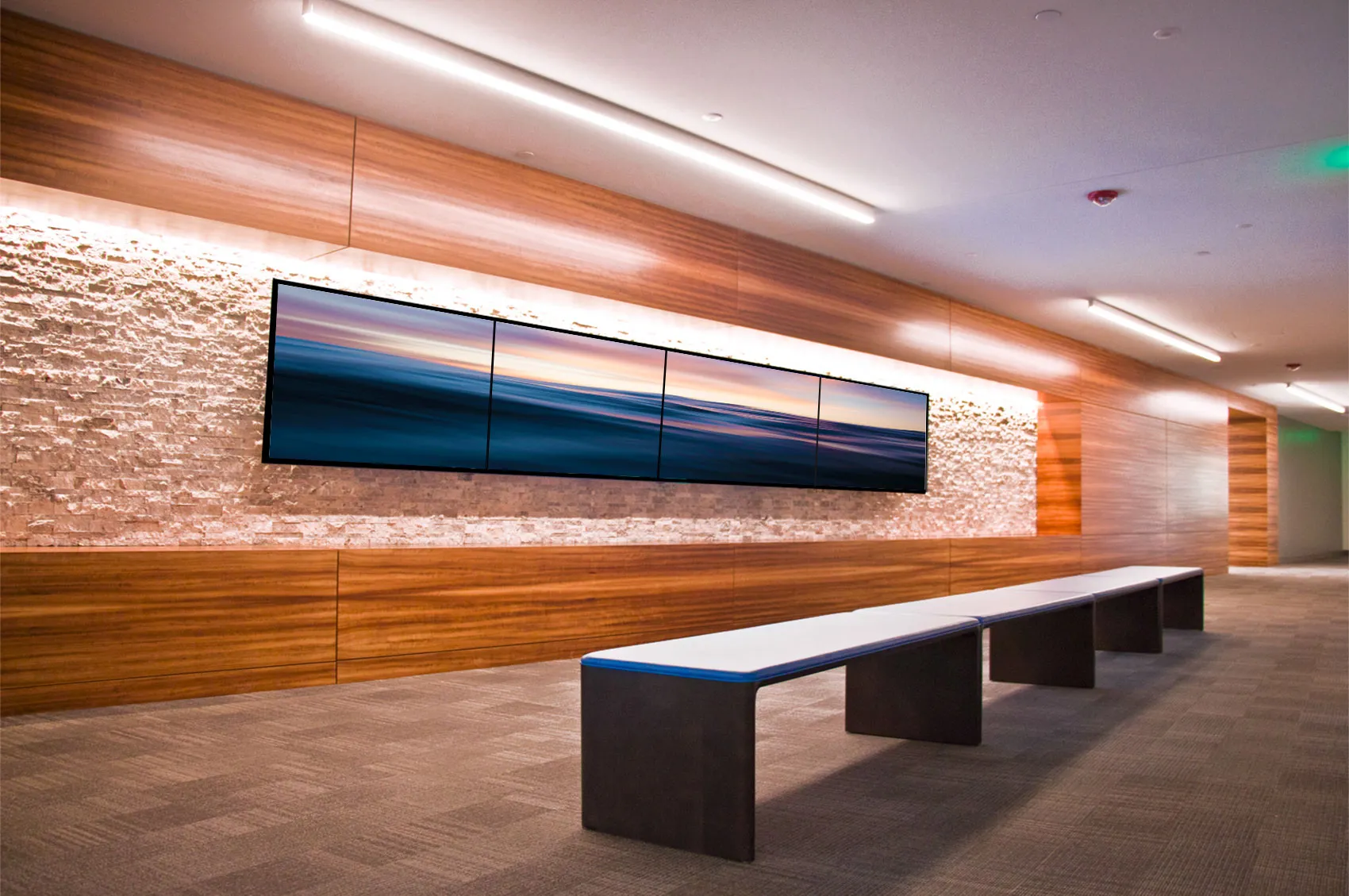
Video Wall Installation
Built for Where People Actually Stand, Not for the Spec Sheet
The rest of the job is what sits behind the panels. A wall of that size carries real weight, needs dedicated circuits rather than a spur off the nearest outlet, throws off heat, and has to be reachable when a cabinet eventually fails. We survey all of that before quoting, and we do the power and the structure ourselves rather than subcontracting it. Where the wall shares a room with conferencing and audio, or sits opposite glass that needs shading to stay readable, that is designed in at the same time.
What We Offer
Survey, specification, structure, power, panels, processing and content. We size the wall to the room and the viewing distance, build the structure behind it, run the circuits it needs, commission it and show your own people how to run it before we hand it over.
LED Video Wall Installation
Direct-view LED walls built from cabinets into a single seamless surface with no bezel lines anywhere. Pitch chosen for the viewing distance, brightness for the ambient light in the room, and the mounting structure engineered for the load before anything is ordered. Includes Samsung and other commercial LED lines.
LCD Video Walls and Display Arrays
Commercial LCD panels in a 2×2, 3×3 or custom array, on bezel-to-bezel displays built for continuous operation rather than the consumer televisions that fail inside a year on a twelve-hour duty cycle. Considerably cheaper per square foot than LED, and the right answer for dashboards, menus and data where thin seams are not a problem.
Controllers, Processors and Content
The part that decides whether the wall gets used after month one. Source switching and scaling, one image across the whole surface or split into zones, scheduled content, IPTV and signage feeds, and simple control your own staff can operate. All of it depends on a reliable network behind the scenes, which we check as part of the survey.
Site Survey, Structure and Power
Wall construction and load, dedicated circuits and heat dissipation, ambient light and sight lines, and service access from the front or the rear so a failed cabinet can be swapped without dismantling the wall. This is the half of the job most integrators subcontract. We are electricians as well as integrators, so it stays with us.
LED or LCD, and How Close Will People Stand?

Direct-View LED
One continuous surface with no seams anywhere, brighter than LCD and scalable to almost any shape or size. It is what you want in a lobby, behind a reception desk or anywhere the wall itself is part of the impression. It costs more per square foot and the pitch you choose drives most of that cost.

LCD Array
Four, six or nine commercial panels in a grid, with a thin seam where they meet — on good bezel-to-bezel displays that is under two millimeters. Considerably cheaper per square foot than LED and entirely appropriate for dashboards, menu boards, schedules and data, where a faint grid line costs you nothing.

Pixel Pitch and Viewing Distance
The rule that saves the most money. Take the pixel pitch in millimeters and multiply by roughly three to get the closest comfortable viewing distance in feet. A 2.5mm wall reads cleanly from about eight feet, a 1.5mm from about five, a 4mm from about thirteen. Buy for where people actually stand, not for the datasheet.

Which One Your Space Needs
Close viewing, seamless impression, unusual shape or a lobby people walk right up to — LED. Fixed data, a set viewing distance and a tighter budget — LCD. If the room is one screen's worth rather than a wall's worth, we will tell you that too, and a single large commercial display costs a fraction of either.
Choose Us
Why Choose Our Video Wall Installations?
Christian Rogers is an electrician by trade and has been installing commercial AV out of Frederick since 2010. On a video wall that matters more than on anything else we fit, because the power and the structure are the parts that fail expensively.
We Survey the Wall Before We Quote the Screen
Wall construction and load capacity, available power, heat, ambient light and where people will actually be standing. Ten minutes of measuring changes the specification more than any amount of discussion about brands, and it is why we will not quote a video wall from photographs and a floor plan.
The Power and the Structure Are Ours
Dedicated circuits sized for the draw, a mounting structure engineered for the weight, and cable management behind the surface. Most integrators subcontract this to an electrician and a fabricator, which means three schedules and three invoices. We hold both trades, so it is one program and one point of responsibility.
Someone on Your Team Can Run It
The most common failure with a commercial video wall is not hardware. It is that the one person who understood the controller left, and it has shown the same slide ever since. We set up simple scheduled content and a control interface any member of staff can operate, and we train more than one of them.
Serviceable From Day One
Cabinets and panels do fail eventually, and how the wall was built decides whether that is an hour or a week. We design front or rear service access in from the start so a single cabinet can be pulled and swapped without dismantling the surface, and we recommend holding a spare on site for anything business-critical.
Fitted Around Your Opening Hours
Lobbies, showrooms and restaurants cannot close for a fortnight. We schedule the disruptive stages — structure, circuits and panel hanging — for evenings, early mornings or weekends, and we are close enough to come back for adjustments without it becoming an event.
What a Video Wall Costs
Video walls are priced on the active display area, the pixel pitch, and what has to be built behind them. The figures below are installed prices covering panels, structure, processing, cabling, commissioning and training. Where a room turns out to need one large display rather than a wall, that is a fraction of any of these and we will say so. The site survey and the quote are free, and the quote is fixed and itemised.
LCD Video Wall, 2×2 or 3×3 — $6,000 to $18,000
Four to nine commercial bezel-to-bezel panels in a grid, with mounts, a controller and installation. The entry point into a genuine video wall, and the right answer for dashboards, menu boards and operational displays.
Direct-View LED, 2.5mm to 4mm — $15,000 to $45,000
A seamless LED surface at the pitch most conference rooms, showrooms and reception areas actually need, with the structure, dedicated circuits and processing included. This is the band the majority of commercial installations land in.
Fine-Pitch LED, 1.2mm to 1.8mm — from $45,000
For lobbies and control rooms where people stand within six feet of the surface and the wall has to hold up to close inspection. Priced on area rather than by the panel, and worth it only where the viewing distance genuinely justifies the pitch.
What Changes the Price
Active display area and pixel pitch above everything else, then whether the wall is LED or LCD, what the structure has to carry, whether power is already close enough, how many sources feed the processor, and whether content needs scheduling or a signage platform. All of it is settled at the survey.

Where We Install Video Walls
We design and install for:
- Corporate lobbies and reception areas across Frederick County, Maryland
- Conference rooms, boardrooms and training spaces
- Retail showrooms, dealerships and product displays
- Restaurants, bars, breweries and taprooms
- Control rooms, operations centers and dispatch desks
- Houses of worship, event spaces and studios
Not sure whether you need a video wall or one large display? Tell us the room dimensions and where people will be standing and we can usually tell you which is right — and it is often the cheaper one, in which case we fit that instead as a single commercial display.
Recent Video Wall Installations
Three commercial installations at three different scales: a lobby wall people walk right up to, a boardroom that had to keep running, and a showroom that needed content changing every week without calling anyone.

A Corporate Lobby in Frederick
A corporate reception where visitors stand within about eight feet of the surface while they wait, which set the pitch at 2.5mm rather than the finer and far more expensive option that had been quoted elsewhere. Sixteen cabinets on a purpose-built frame, two dedicated circuits run for the draw, and rear service access designed in so a single cabinet can be pulled without touching the rest. Content scheduled to change through the working day.

A Boardroom in Gaithersburg
A 3×3 LCD array replacing two projectors that had never been bright enough with the blinds open. Commercial bezel-to-bezel panels, a processor handling four laptop inputs and the room camera, and a single wall panel that switches sources without anyone opening a laptop first. Structure and circuits went in over a weekend so the room was back in use on the Monday.

A Showroom Floor in Frederick
A dealership wanting product content on the wall behind the desks, changing weekly, run by the sales manager rather than by us. A 2×2 LCD array at a viewing distance of around fifteen feet, on a signage platform with a scheduling calendar simple enough to be handed over in twenty minutes. Two members of staff were trained rather than one, which is the part that keeps it current a year later.
What Our Clients Say
Pulled live from our Google Business Profile. Commercial and residential AV, display and electrical work across Maryland and the surrounding area — nothing edited, nothing hand-picked.
Posted on Google
 Nick Marzella
Trustindex verifies that the original source of the review is Google.
Can't say enough about the great job that Cristian did for us: cleaning up a mess of wiring and connections to my tv and audio system set up that took me twenty years of DYI tech work. Very efficient and reasonable pricing. Very satisfied/happy!Posted on Google Zara WaltersMy technician, Cristian, was extremely professional and knowledgeable. He went above and beyond to assist me with both stereo repair as well as the electrical work. I strongly recommend him and will use him again if needed.Posted on Google
 Victor PengCristian did a great job mounting my TV above the fireplace (with a MantelMount MM700) as well as placing a new power outlet for a clean, cable-free look. I’m very happy with the look of our new home entertainment center.Posted on Google
 Hector RodriguezVery professional and friendly. Mr. Rogers was recommended by Archer HiFi and I'm glad I found such a dependable and honest tech.Posted on Google
 Richard OmersoI just had an informed conversation with this very honest gentleman concerning repairing or replacing my old Cerwin-Vega AT-8 speakers. I highly recommend him.Posted on Google
 1996nyyChristian Rogers did a great job rewiring our components. He was thorough and patient explaining the operation. Highly recommend. John McLPosted on Google
 James FittsHired Nerical to run cat6 throughout my home. Christian was professional and timely. The installation was clean and exceeded my expectations. Highly Recommended.Posted on Google
 Tricia CassonChristian helped us mount our TV and hide the cables, he added new outlets and made the process smooth and easy. Highly recommend! Thank you Christian!Posted on Google
 Samantha WrightI needed help with a legacy surround sound system and so I called Nerical - the team was very kind, informative, and all-around helpful. Would definitely recommend!Posted on Google
 BB AlaEasily one of the most skilled and comprehensive home automation/electronics installer in the area. Been working with Cristian for over a decade now on various projects. Always dependable. Always gets the job done. Highly skilled.Verified by TrustindexTrustindex verified badge is the Universal Symbol of Trust. Only the greatest companies can get the verified badge who has a review score above 4.5, based on customer reviews over the past 12 months. Read more
Video Wall Questions
The questions we get asked most often before a first visit.
How much does a video wall cost?
An LCD video wall in a 2×2 or 3×3 array runs $6,000 to $18,000 installed, covering the panels, mounts, controller and installation. A direct-view LED wall at 2.5mm to 4mm pitch – the range most conference rooms, showrooms and reception areas need – is $15,000 to $45,000 including structure, dedicated circuits and processing. Fine-pitch LED at 1.2mm to 1.8mm starts around $45,000 and is priced on area. Where a room only needs one large commercial display, that is a fraction of any of these and we will tell you so. The site survey and the quote are free.
LED or LCD - which should we choose?
LED where the surface has to be seamless, bright, or an unusual shape, and anywhere people walk right up to it – lobbies, reception walls, retail. LCD where the content is data, dashboards, menus or schedules and a thin seam between panels costs you nothing; on good bezel-to-bezel commercial displays that seam is under two millimeters. LCD is considerably cheaper per square foot. The deciding factor is usually how close people stand and whether the wall itself is part of the impression.
What pixel pitch do we need?
Take the pixel pitch in millimeters and multiply by roughly three to get the closest comfortable viewing distance in feet. A 2.5mm wall reads cleanly from about eight feet, a 1.5mm from about five, and a 4mm from about thirteen. The most expensive mistake on a video wall is buying a finer pitch than the room can show you – at twenty feet back, nobody can tell a 1.5mm wall from a 4mm one, and you have paid two or three times over for it. We measure the viewing position at the survey and specify from there.
How much power and structural support does a video wall need?
More than most people expect, and it is the part that gets underestimated. A wall of any size needs dedicated circuits sized for the draw rather than a spur off the nearest outlet, and the mounting structure has to carry the full load of the cabinets plus any service framework. Heat dissipation matters in an enclosed space, and service access needs designing in from the start so a failed cabinet can be swapped without dismantling the surface. We handle the electrical and the structure ourselves rather than subcontracting them, which is unusual for an AV integrator.
Can our own staff run it, or do we need an AV technician?
Your own staff, and we set it up that way deliberately. The most common failure with a commercial video wall is not hardware – it is that the one person who understood the controller has left, and it has been showing the same slide ever since. We configure scheduled content and a control interface simple enough to hand over in twenty minutes, and we train at least two people rather than one.
Do you install video walls outside Frederick County?
Yes. We work across Frederick County and out into the neighboring Maryland counties – Frederick County and out into Washington, Carroll and Montgomery Counties. A video wall is a multi-week project rather than a call-out, so the distance is rarely the deciding factor. Call (240) 372-5809 and we will tell you straight away whether we can cover you.
How long does installation take, and will it disrupt our business?
Most commercial installations run between three days and two weeks depending on the structure and the electrical work involved. We schedule the disruptive stages – building the structure, running circuits and hanging panels – for evenings, early mornings or weekends, because lobbies, showrooms and restaurants cannot close for a fortnight. Commissioning and training happen during normal hours once the wall is live, and those are quiet.